
Dental Cap vs Crown? Understand the Key Differences

Updated: 4 hours ago
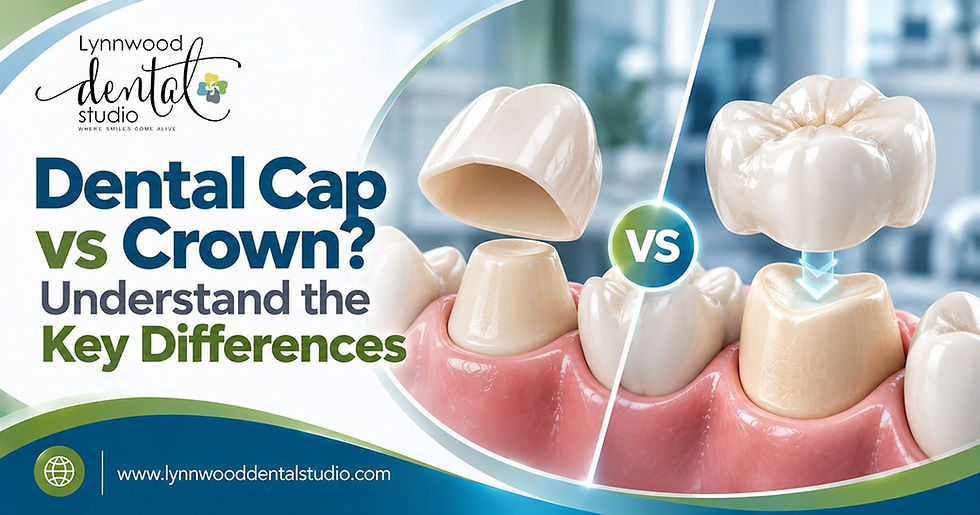
When a tooth cracks, weakens, or breaks from an accident or decay, your dentist may recommend a restorative cover to protect it from further damage. When looking for restorative protection, you may often hear two terms: dental cap and dental crown. But what is the difference between a dental cap and a crown?
In most cases, a dental cap is just another less formal name for a dental crown. However, some dental offices may refer to a tooth cap as a smaller or partial restoration, such as an inlay or onlay, that repairs only part of a tooth. Understanding the difference between dental crowns and caps can help you choose your right treatment option confidently.
What Is a Dental Crown?
A dental crown is a custom-made, tooth-shaped restoration designed to cover the remaining part of a broken or weak tooth. It protects the tooth structure from further damage while restoring its shape, size, strength, and appearance.
A damaged tooth can affect your bite and your confidence. Therefore, a dentist may recommend a crown to restore the tooth’s natural appearance and strength.
Dental crowns in Lynnwood are also often recommended after an intensive treatment such as a root canal (RCT) to protect the affected area.
Other instances when a dentist may recommend a crown:
When a tooth has extensive decay
A large filling is used
There are significant cracks, fractures, or substantial wear.
Dental implants
Because a crown is designed for a particular tooth, it must exactly match the natural tooth’s size, shape, and appearance, so the restoration fits properly.
Dental crowns are of two types: temporary crowns and permanent crowns.
Temporary crowns are used to protect a weak tooth during an ongoing treatment. A permanent crown is designed to function much like a natural tooth.
What Is a Dental Cap?
The term tooth cap can have different meanings depending on whom you ask. Some people use it as an everyday term for a dental crown. Some dentists may also use the term when referring to partial crowns like an inlay or onlay, which is a specialized restoration designed to repair a specific area of a tooth.
When a tooth is damaged or cracked but still has enough healthy structure, a partial dental cap may be used to avoid needing a full crown.
In short, a tooth cap may refer to a type of dental crown that does not cover the entire tooth. Instead, it restores and protects only the damaged portion of the healthy natural tooth.
Dental Cap vs Crown: Key Differences
The major difference between a dental cap and a crown is how much of the tooth they cover.
A crown is often custom-made to cover the entire visible portion of a treated or damaged tooth.
A dental cap, also called a partial restoration, such as an inlay or onlay, covers only the affected area, whether it’s the biting surface or one of the cusps.
Installing a crown or cap may require removing some of the healthy tooth structure. This is why understanding the difference is important, so you know how much tooth may be removed during treatment.
Dental Cap vs Dental Crown
Dental Cap | Dental Crown | |
Coverage | Restores only part of the affected tooth. | Covers the entire visible tooth. |
Tooth preparation | Generally requires more tooth preparation (structure removal) because space must be created for the crown to sit. | Preserves more healthy enamel and tooth structure (less removal). |
Who is it for? | Often recommended for teeth that are significantly weakened or damaged | May be suitable for more localized damage. |
Placement | Permanently cemented over the prepared tooth. | Securely fit to the tooth but can be replaced if it becomes damaged or fails. |
Appearance | natural-looking | natural-looking |
When Might You Need a Dental Crown?
A full dental crown is appropriate when a tooth has lost substantial structure, is severely damaged, or needs comprehensive protection. For example, a severely decayed tooth may be too weak to support a regular filling or partial cap. Similarly, a cracked or fractured tooth may need a complete crown to protect the remaining structure and prevent further damage.
Crowns can also protect or restore teeth that have become worn, distorted, or discolored. For patients receiving high-level treatments such as a root canal or dental implant, a crown can serve as the visible replacement for the natural tooth.
Ceramic and porcelain are two of the most popular materials used for constructing custom dental crowns. The right material depends on the tooth’s location and condition, your bite, cosmetic preferences, and functional goals. Both options can closely resemble natural teeth. Other options such as all-resin crowns, porcelain-fused-to-metal, base metal alloy, or gold alloy crowns are also available for patients with specific needs or preferences.
When Might a Tooth Cap or Partial Restoration Be Better?
If the damage is limited to one area of a tooth, your dentist may recommend a partial tooth cap, which covers only the affected area while preserving as much of the natural structure as possible. Also called an inlay or onlay, this technique is useful for minor cracks, fractures, cavities, or damaged or worn chewing surfaces.
Partial restorations are ideal when the remaining tooth structure is strong enough to support them. Porcelain or ceramic materials are used to create a partial cap that perfectly blends with surrounding teeth.
However, not all damage can be restored with a partial tooth cap. If a tooth is extensively weakened or doesn’t have sufficient healthy structure, a full crown may be the best way to provide the protection and strength it needs.
Conclusion: Which Option Is Right for You? Dental Crown or Cap
Choosing between a dental cap and crown is not simply about which looks better. Your dentist may evaluate several factors, such as the location and condition of your tooth, the amount of healthy tooth structure remaining, the extent of damage, your bite, and your overall oral health, to determine the best treatment option.
When you visit us at Lynnwood Dental Studio, we perform various tests and scans to determine the exact condition of your tooth, based on which we explain which restoration is most appropriate for your situation. We aim to protect your natural tooth whenever possible while restoring your natural smile. This means if a partial cap does the job, we’ll never recommend a full crown, which may require removing a substantial tooth structure.
If you are searching for reliable dental crowns near me in Lynnwood or confused between crowns and caps, professional evaluation is the best place to start. Contact Lynnwood Dental Studio to schedule a consultation with one of our expert, friendly dentists in Lynnwood. A timely evaluation and the right treatment can help prevent minor tooth damage from escalating into a long-term problem.


Comments